Why Workflow Beats Prompts: The Case for Purpose-Built Design AI
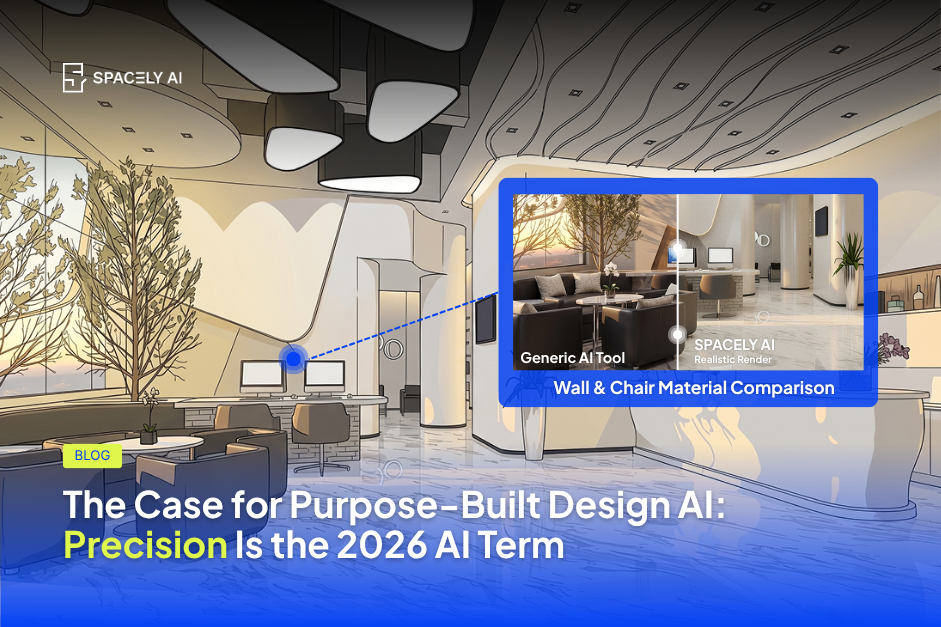
ChatGPT and Nano Banana can generate room images. So why do 580,000+ designers use Spacely AI instead? The answer is workflow — and it changes everything about how AI fits into design.
A designer can ask ChatGPT to "make a Scandinavian living room with a navy sofa" and get an image back in seconds. That image will look fine. But later, when the client says "keep everything but change the rug to something warmer," the designer is stuck. The whole image regenerates.
This is the gap between a generative AI image tool and a generative AI design workflow. And it's the gap that determines whether AI becomes a real part of a designer's process — or just a curiosity that lives in a screenshot folder.
Spacely AI is built for what happens after that image — the iteration, the client feedback, the version control, the deliverable.
The prompt-to-image gap
Generic AI tools operate on a simple loop: write a prompt, get an image, write a new prompt, get a new image. Every output is a new beginning. The designer is the only thing connecting one render to the next — which means every revision request from a client becomes a manual reconstruction of context.
Client work requires:
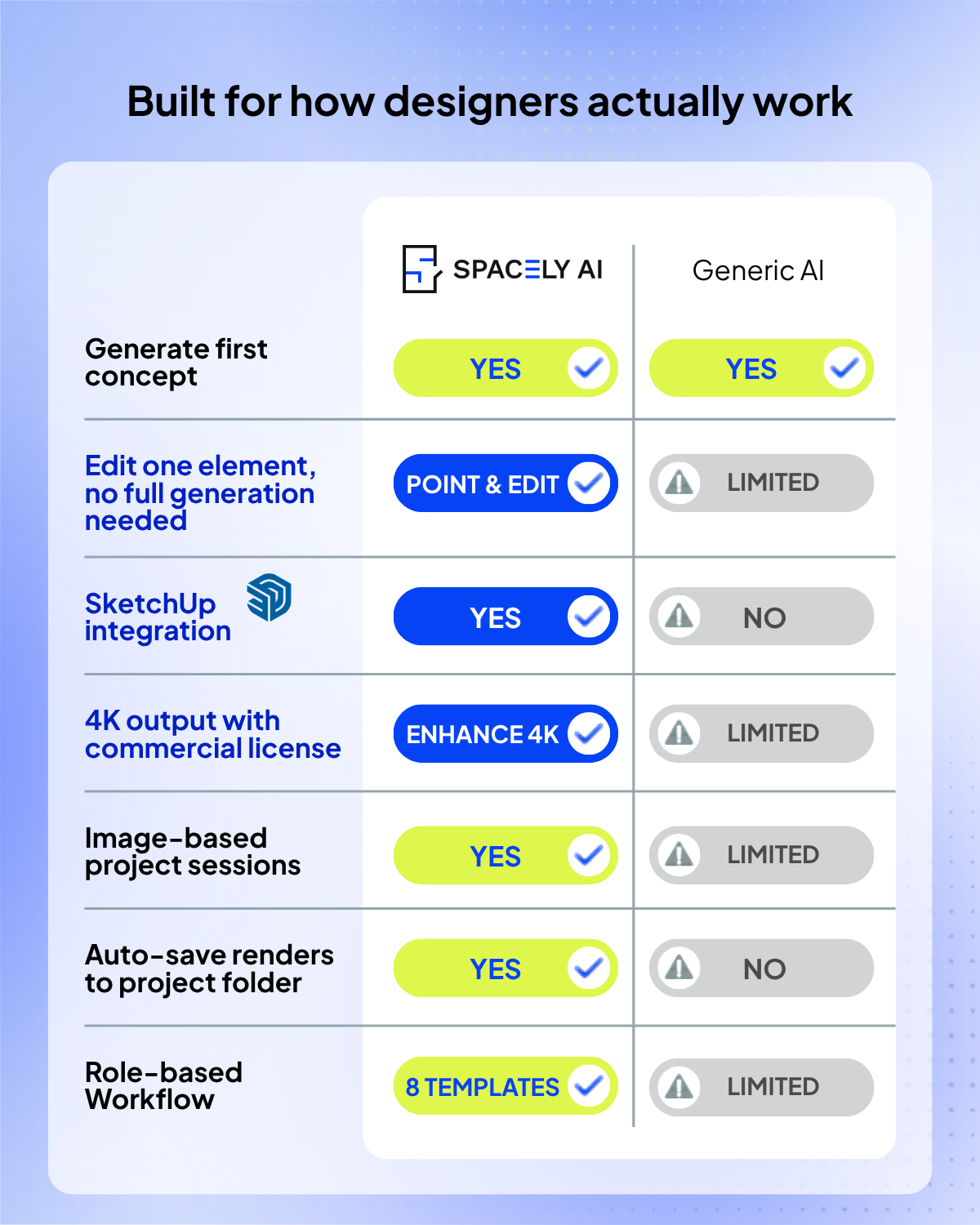
- A project that persists. Every render lives inside a project, ordered chronologically, accessible across devices.
- Controlled changes. Modify one element — a rug, a light fixture, a wall finish — without disturbing the rest of the composition.
- Version comparison. Show the client three options of the same room, side by side, with consistent framing.
- Resolution that's deliverable. 4K output, watermark-free, with a commercial license — not a 1024×1024 thumbnail.
- Consistency across rooms. Apply the same material palette to a kitchen, a living room, and a primary bedroom — without each one becoming a different design language.
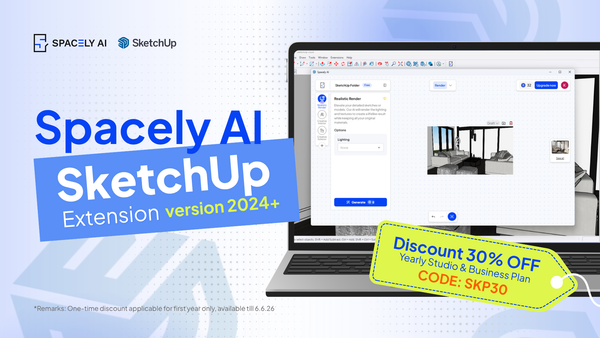
- Professional tool integration. Take your SketchUp model from concept to client-ready render — without switching platforms. Spacely AI is now available as a SketchUp extension, version 2024+.
Why this matters now
Generic AI has been great for single-image generation. The next round of differentiation isn't about whose model produces a prettier sofa. It's about whose system actually fits into a designer's day.
Spacely AI's bet is that the future of AI in design isn't about better prompts — it's about better systems. The best generative AI in the world doesn't fix a workflow that's broken. And the most powerful tool a designer can have isn't the one that produces the most impressive single image. It's the one that fits into how they already think, organize, present, and revise.
That's what "workflow over prompts" means. Not a slogan — a different bet about where the value actually is.
Q: Is Spacely AI worth it if I already use ChatGPT or Gemini for design ideas?
A: While ChatGPT or Gemini are useful for early ideation and conceptual exploration. Spacely AI takes over once a project becomes real client work — when revisions, version control, project organization, 4K output, and SketchUp integration matter. Most users keep both tools. Spacely AI is the one that produces the deliverable.
Q: Do I get a commercial license to use Spacely AI renders in client work?
A: Yes, on the Studio plan and above. Studio ($45/month) includes a commercial license, watermark-free output, and 4K downloads — meaning renders can go directly into client presentations, MLS listings, and proposals without rework.
Get started
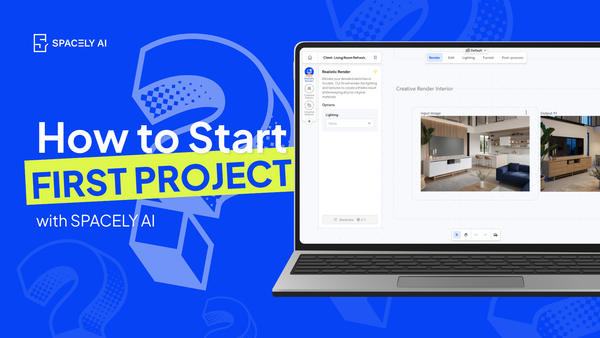
→ Watch the full tutorial on YouTube
For more information and media inquiries, please contact
Website: spacely.ai
Facebook: facebook.com/spacelyai
Instagram: instagram.com/spacely.ai
Email: hello@spacely.ai