Why 1997 Software Still Designs the World
Inspired by Andreessen Horowitz, this argues AEC inefficiency isn’t about old tools but broken workflows. The real losses are from late decisions and rework. Learn how to use AI to align clients earlier, cut revisions, and run more efficient projects.
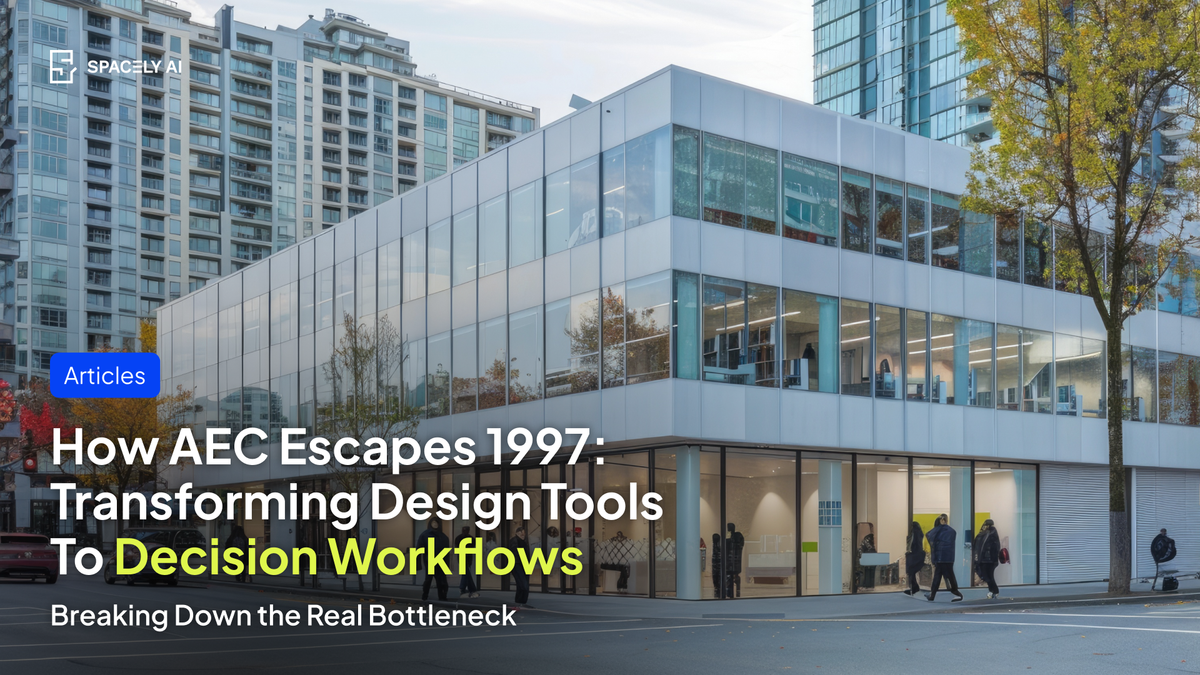
A recent article by Andreessen Horowitz titled “Every Building You’ve Ever Been In Was Designed By Software Built in 1997” highlights a reality most people overlook: the modern built world still runs on decades-old software. It’s a sharp observation—and an important one. But the deeper implication is not just about outdated tools. It’s about why the industry continues to operate this way, and what that means for firms trying to adopt AI today.
The easy conclusion is that AEC is inefficient because the tools are old. That better software, faster rendering, or AI will fix the problem. But if this were simply a tooling issue, it would have been solved already. The reality is more structural. The industry is not slow because it lacks innovation. It is constrained because the systems it depends on are deeply embedded into how work gets done.
Tools like Autodesk Revit are not just design software. They are the system of record, the collaboration layer, and the standard that architects, engineers, and contractors are trained on. Over time, they have become infrastructure. And infrastructure is not easy to replace. Switching systems is not just about learning a new interface. It requires retraining teams, rebuilding libraries, aligning external partners, and changing workflows across entire projects. The cost of leaving is often higher than the cost of staying.
This is why the industry appears “stuck.” Not because firms don’t want better tools, but because the system around those tools makes change difficult.
1. The Coordination Problem
This structural lock-in has real consequences. The inefficiencies seen in construction today do not primarily come from execution on-site. They originate earlier—during design and coordination. Many project delays, cost overruns, and rework issues can be traced back to this phase. This is where decisions are made, often with incomplete information, across multiple stakeholders who are not always aligned.
When a change happens in one part of a design, it doesn’t automatically propagate across everyone involved. Information moves through files, exports, and communication layers that are inherently fragmented. Someone misses an update. A dependency isn’t caught. The issue compounds quietly, and by the time construction begins, it is already embedded in the project. What shows up later as rework is simply the result of earlier misalignment.
2. Why Faster Output Isn't Enough
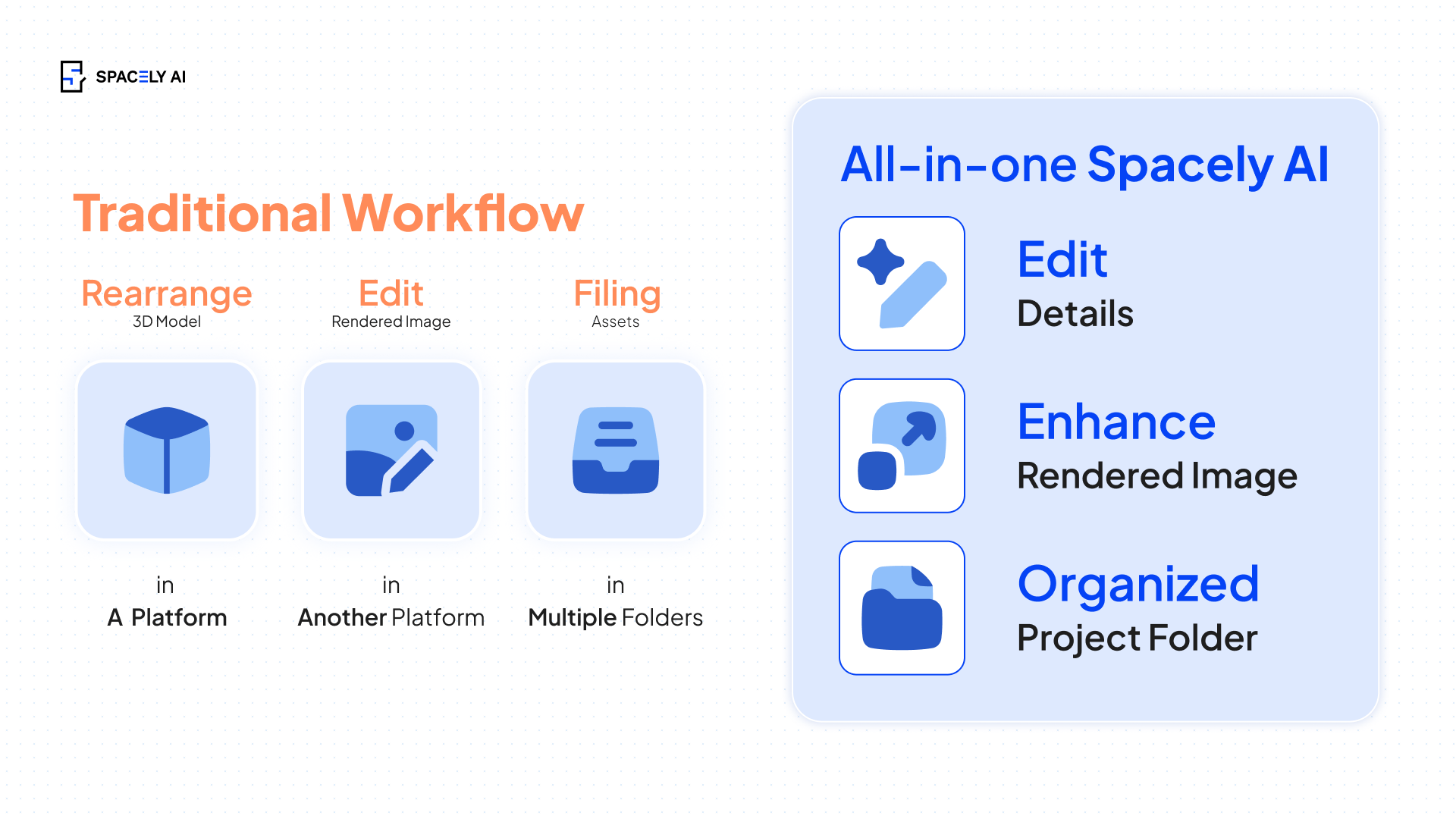
This is where many AI efforts fall short. The assumption is that if design can be made faster—through rendering, automation, or generative tools—the overall process will improve. These tools do increase productivity. They reduce the time it takes to create outputs. But they don’t fix coordination, decision ownership, or workflow continuity. They optimize individual steps, not the system.
The real bottleneck is not how fast designs are created. It is how decisions are made and aligned across stakeholders.
Architects, interior designers, engineers, contractors, and clients all operate with different tools, timelines, and expectations. There is no single system that ensures decisions are tracked, validated, and aligned before moving forward. As a result, even if each tool improves, the overall process still breaks down at the points where people intersect.
This is why replacing core systems has been so difficult. It’s not just a product challenge. It’s a systems challenge. Any new solution must handle complexity—design constraints, regulations, multi-party coordination—while also integrating into existing workflows and delivering immediate value. Most attempts to replace incumbents have failed because they focused on building a better tool, rather than addressing the workflow around it.
3. The Shift from Tools to Workflows
What is changing now is not just the availability of AI, but what AI enables. It reduces the cost of generating designs and allows teams to iterate quickly. But more importantly, it shifts where the bottleneck sits. When creating designs becomes fast and cheap, the constraint moves to coordination and decision-making.
This is where the real opportunity lies.
Today, most solutions in the market focus on outputs—better renders, faster visuals, more automation. This is the easiest layer to build, and also the most crowded. A more practical approach is to integrate into existing workflows and improve how teams collaborate and make decisions. The hardest, but most valuable, layer is owning the workflow itself—structuring how projects move from idea to execution.
This shift—from tools to workflows—is what will define the next phase of the industry.
4. The Playbook for Design Firms
For interior design firms and architecture studios, this is not theoretical. It translates directly into how projects are run, how clients are managed, and ultimately how revenue is generated.
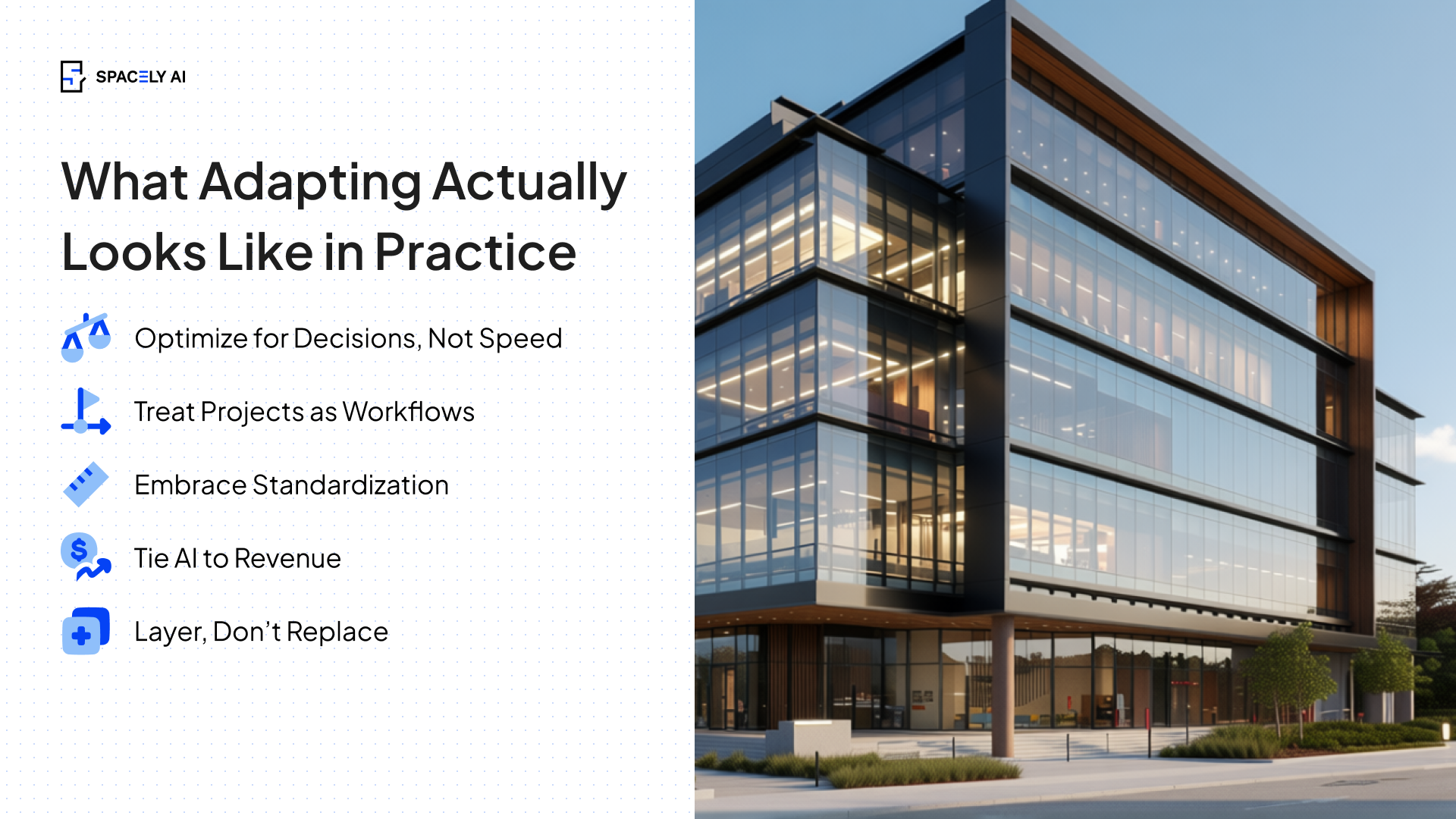
The first step is understanding where inefficiency actually comes from. It is rarely the time it takes to produce a render. It is the number of revisions, the late-stage changes from clients, and the misalignment between teams. Reviewing recent projects often reveals the same pattern: decisions made too late, expectations not aligned early, and repeated work that could have been avoided.
Instead of optimizing for speed, firms should optimize for decisions. Faster outputs don’t help if clients are still unsure or keep changing direction. What works is using visuals earlier in the process to force clarity. Showing multiple directions upfront, structuring client conversations around choosing a direction rather than giving open-ended feedback, and reducing ambiguity early. This shortens cycles and reduces rework.
Projects also need to be treated as structured workflows, not ad hoc collections of files. Every project should have a clear container that includes all versions, visuals, and decisions. Defined stages—concept, direction, refinement, final—help teams move forward with clarity instead of looping endlessly. Without this structure, context is lost and work gets repeated.
Standardization is another overlooked lever. Many inefficiencies come from variation across team members. Different ways of presenting, different levels of detail, different expectations with clients. Simple internal standards—how many options to present, how to structure updates, when to move forward—create consistency. And consistency reduces friction.
AI, when used correctly, should be tied to revenue, not just output quality. Its value is not in making images look better. It is in helping firms win projects faster and close decisions earlier. Using AI to create proposal visuals quickly, explore multiple directions during the pitch stage, and align clients before work begins has a direct impact on conversion rates and project timelines.
Importantly, this does not require replacing existing tools. Core systems like Revit or SketchUp remain. The shift happens by layering new capabilities on top—using AI for ideation, communication, and iteration—while keeping the underlying workflow intact. Adoption needs to be incremental to avoid disruption.
Finally, firms should focus on reducing rework, not just improving output. Tracking the number of revisions per project, identifying where time is lost, and understanding patterns—unclear briefs, late changes, miscommunication—provides a clear path to improvement. Most of the gains come from fixing these upstream issues, not from producing better final visuals.
5. How Spacely AI is Evolving
This is where Spacely AI is evolving its approach.
The initial wave of AI in design focused on speed—generating faster renders and reducing manual work. But speed alone does not solve the core problem. The shift is toward embedding AI into the workflow itself. Moving from isolated outputs to structured projects, from one-off generations to continuous processes that guide decisions and maintain context.
Instead of asking how to generate better designs faster, the focus becomes how to move a project forward toward a decision. This means helping teams explore options quickly, align with clients earlier, reduce back-and-forth, and create clarity before execution begins.
Driving Decisions Over Designs
In AEC, value is not created when an image is generated. It is created when a decision is made with confidence and alignment.
The industry is not broken because it uses old software. It is constrained because that software became the foundation of how work is done. The next wave of innovation will not come from better tools alone, but from systems that reshape workflows and reduce friction across the entire process.
The firms that understand this shift—from creating designs to driving decisions—will not just work faster. They will win more projects, reduce rework, and operate more efficiently.
And over time, that is what will redefine how buildings are designed.
For more information and media inquiries, please contact
Website: spacely.ai
Facebook: facebook.com/spacelyai
Instagram: instagram.com/spacely.ai
Email: hello@spacely.ai